From the Frontier Press
Two clippings from Octobers long past, copied off the page as it was printed. The spelling is the printers’ own.
Buffalo Bill’s Farewell Tour.The scout will quit the stage for his cattle, the paper reports
The Cheyenne Daily Leader · Cheyenne, Wyoming Territory · Oct. 27, 1877
The Leader printed it plainly: “This will be the last season that Buffalo Bill (W. F. Cody) wil travel as a theatrical star.” (“Wil” is the Leader’s spelling.) The tour would run to San Francisco and back to Omaha. There the troupe would disband, and Cody would go to his ranch on the North Platte “to remain there the rest of his life as a cattle dealer and gentleman farmer.” He had 4,500 head and hoped for 10,000. The rest of his life turned out to be busy. His stage company kept touring for several more seasons. In May 1883 he opened his Wild West at Omaha, and it ran, in one form or another, for about thirty years. In 1910 he set out on yet another round of farewell tours, which took nearly three seasons to finish. A good farewell, it seems, bears repeating. 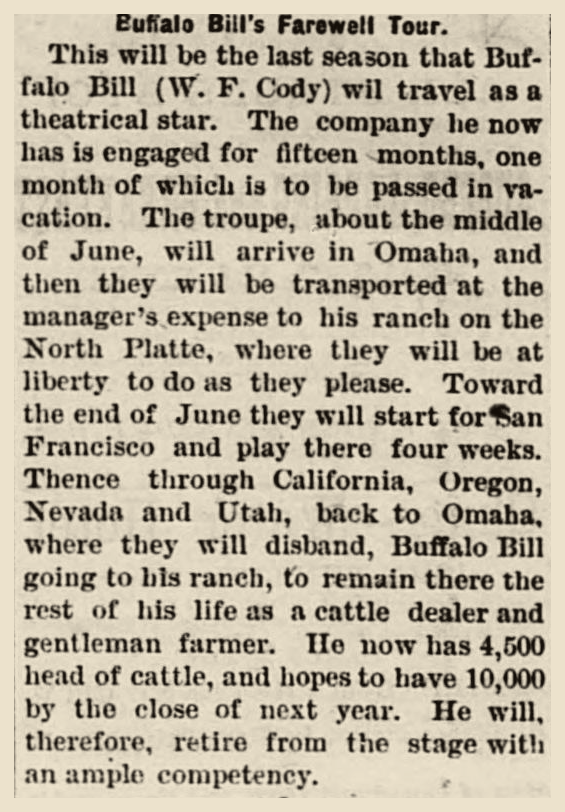
Courtesy of Chronicling America, Library of Congress. |
Reasonable Electric Rates.The Schedule Adopted by the Flagstaff Company.
Arizona Republican · Phoenix, Arizona Territory · Oct. 15, 1895 · from the Flagstaff Sun
The Republican passed along a notice from the Flagstaff Sun. The Flagstaff Electric Light company meant to make electric light popular in town, and it posted rates for private homes: one sixteen-candle-power light for $1.10 a month, two for $1.60, three for $2, ten for $3.50, and “twenty for $5.” The Sun’s forecast was that the light “will probably be placed in every residence in Flagstaff.” Sixteen candle power was the usual size of a household lamp in those years, about the light of sixteen candles burning together, with no wick to trim. Read the schedule twice and the arithmetic does the selling. One lamp cost $1.10 a month. Twenty came to a quarter apiece. 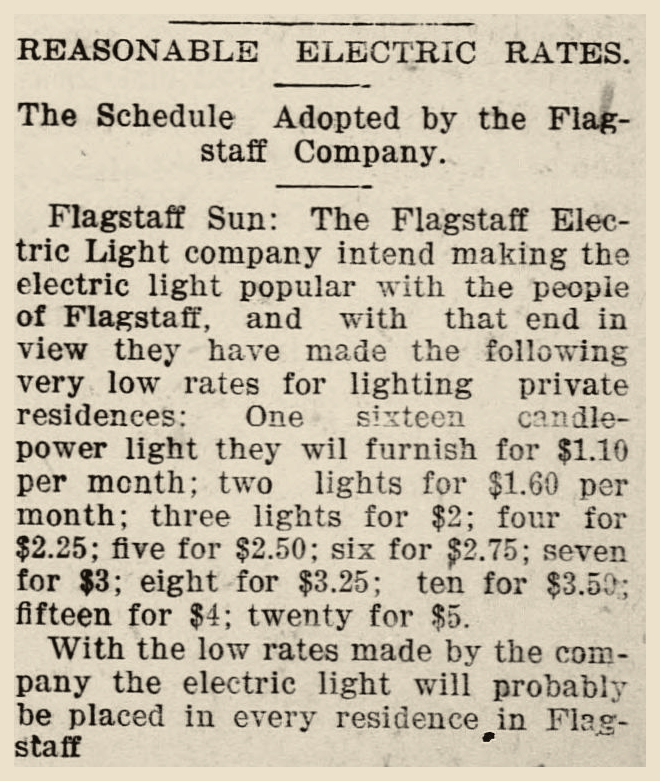
Courtesy of Chronicling America, Library of Congress. |
Courtesy of Chronicling America, Library of Congress.
The electric-rates item first appeared in the Flagstaff Sun, as reprinted by the Arizona Republican.